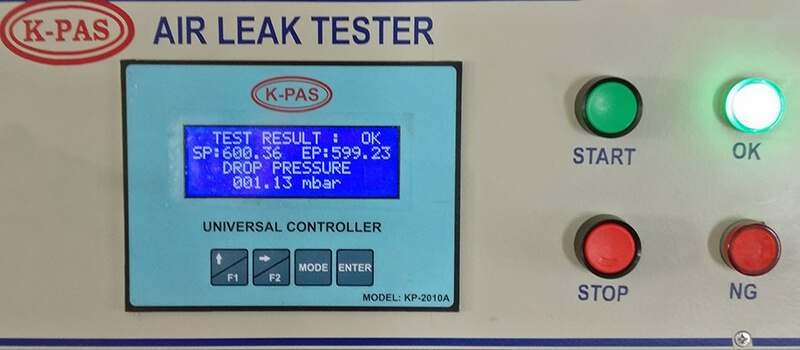
Leak Testing Machine
Manufactured with utmost precision and perfection, the range of Leak Testing Machines that we offer is designed and developed in strict conformation with industry defined norms and standards. Fabricated utilizing excellent grade raw material and latest technologies, these machines are made available in customer specified acceptable leakage rates/leak limits so that they can reliably check how much item is leaking. We offer the range at industry leading prices to the clients.
Our Products
Tank Leak System
K-PAS Tank leak testers judge leaks by pressurizing the inside (or outside) of sealed work by air and measuring the pressure change. When the master with no leaks and work with leak are pressurized, the pressure of the work with leak will decrease generating pressure difference between the master and work. The leak is measured from this pressure difference.This differential pressure type air leak test is used for leak check.
A leak is a flow of gas (or liquid) through the wall of a vessel (via an imperfection such as a hole, crack or bad seal). Leaks require a pressure difference to generate the flow; they always flow from higher pressure to lower pressure.
Test part is done using client plastic Mold and as per customer requirement. K-PAS TANK LEAK TESTER is used to determine the Air leak in test component which is used.
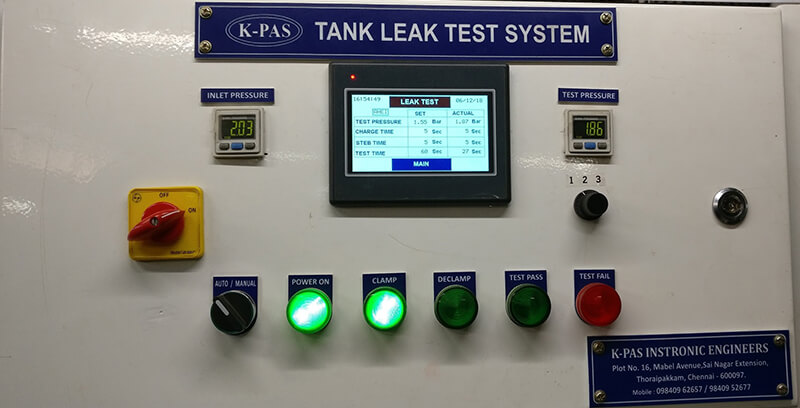
The Main panel consists of a power ON and an Auto/Manual switch for the test settings, and a power ON Indicator along with Clamp and De-clamp Indicator and finally the Test Result Indication.
We can start the process through HMI and we have to set the inlet and the charge pressure in the settings menu.
Dunk Tank Leak System
K-PAS Dunk tanks are a widely used method for location of leaks in complex assemblies and products with air bubbles present around the leaking area.differential pressure or vacuum decay is used first to qualify a “tight” part before hand, one may then need to locate the leak afterwards using this underwater method. If the part leaks, simple decay of pressure does not show the leakage path. If a part fails the quantifiable test then one method of detecting the leak path is to submerge in water and look for bubbles.
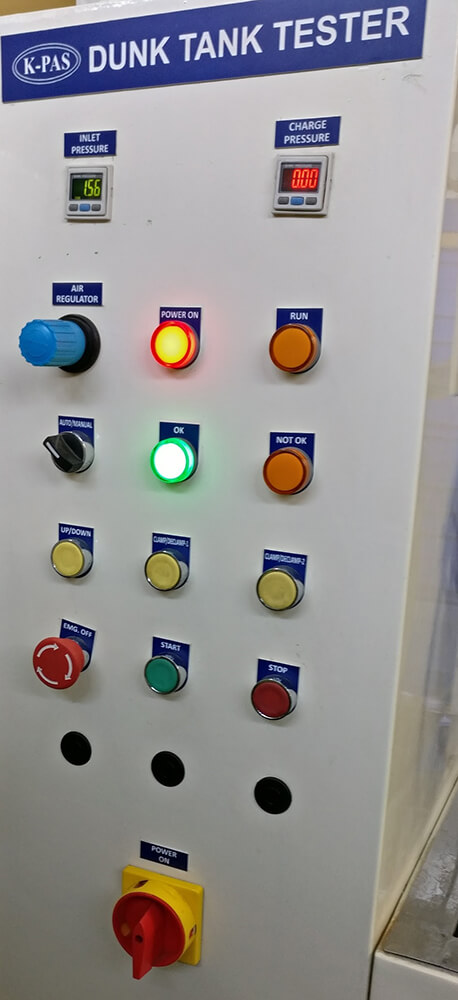
K-PAS DUNK TANK TESTER is used to determine the leak in test product which is used. The Main panel consists of a POWER ON SWITCH and an Auto/Manual Selector switch for the test settings, and a power on Indicator along with Clamp and De-clamp Indicator and finally the Test Result Indication. We can start the process by pressing START button and we have to set the inlet and the charge pressure in the air regulator in the front panel. This process is to test by immersing the test part in Water by submerging it in a tank so that all sides are covered and applied pressure in it so as to check if there is bubbles in it which means there is leak in the part.
DUNK TANK LEAK TEST SYSTEM
- K-PAS Dunk Tank Leak Test System is a non-destructive testing setup designed to detect leaks in components or assemblies by submerging them in water and observing for air bubbles. The component is pressurized with air or an inert gas, and any escaping gas will create visible bubbles, indicating the location and severity of a leak.

- Make : K-PAS
- Model : KM-1008
- Input : 230V AC
- Pressure : 0 – 10 BAR MAX
- Simple and Visual Leak Detection
- Pressure Relief Valve for Overpressure Protection
- Corrosion-resistant Frame
POWER STEERING PUMP TEST RIG
- A Power Steering Test Rig is an electromechanical and hydraulic test system designed to simulate real driving conditions and test the performance, functionality, leakage, and endurance of power steering units under controlled conditions.
- These test rigs simulate real-world operating conditions (pressure, flow, and electrical input) to ensure steering components meet safety, efficiency, and durability standards

- Make : K-PAS
- Model : KM-774
- Input : 415V 3PH
- Output : 415V 3PH
- Pressure : 150 – 400 BAR MAX
- Wide Pressure Range: Operates between 150 to 400 bar to simulate various steering loads.
- High-Efficiency Motor Drive: 415V, 3-phase electric motor with VFD control for variable speed.
- Data Monitoring: Real-time display and logging of pressure, flow, and temperature.
- Leak Testing: Detects internal/external fluid leakage under load.
- Temperature Control: Built-in oil cooling system for long-duration tests.
Air Leak Tester
An Air Leak Tester is a device used to detect and measure leaks in a sealed object or system by introducing pressurized air (or sometimes other gases) and monitoring pressure changes or airflow that indicate the presence of leaks. It helps ensure the integrity, safety, and performance of products or systems by identifying any unwanted air escape points.
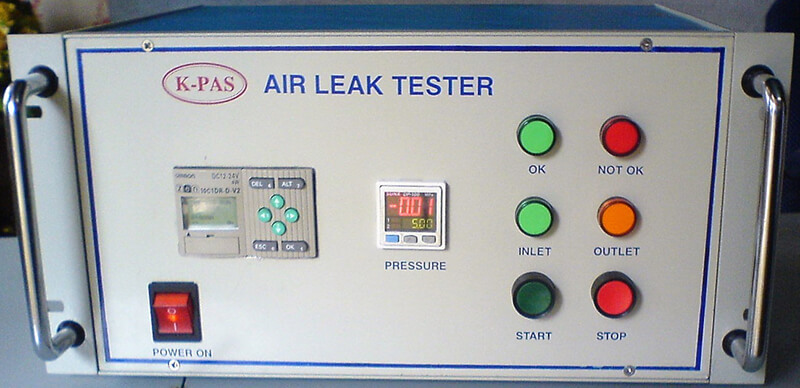
Pressure & Vacuum Leak Testing Machine
K-PAS Air leak testers judge leaks by pressurizing the inside (or outside) of sealed work by air and measuring the pressure change. When the master with no leaks and work with leak are pressurized, the pressure of the work with leak will decrease generating pressure difference between the master and work. The leak is measured from this pressure difference. This differential pressure type air leak test is used for leak check.
A leak is a flow of gas (or liquid) through the wall of a vessel (via an imperfection such as a hole, crack or bad seal). Leaks require a pressure difference to generate the flow; they always flow from higher pressure to lower pressure. Leaks, even when they are small, can have a significant impact on the performance of a part or component or cause equipment to fail. Cracks and faulty seals are often the cause of these leaks, but they can often be detected by conducting vacuum testing on components prior to manufacturing.
Vacuum leak testing is the principal leak test method for testing sealed parts that could have leakage from an external source into their housings and casings. Prime tests for vacuum leak test procedures include:
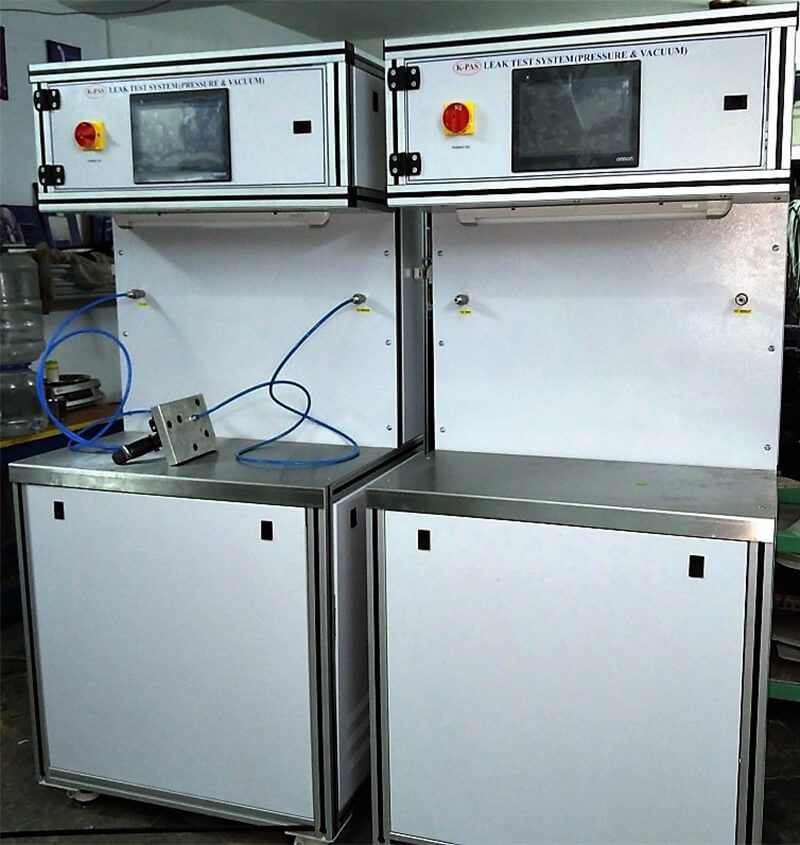
Air Leak Tester
K-PAS Air leak testers judge leaks by pressurizing the inside (or outside) of sealed work by air and measuring the pressure change. When the master with no leaks and work with leak are pressurized, the pressure of the work with leak will decrease generating pressure difference between the master and work. The leak is measured from this pressure difference. This differential pressure type air leak test is used for leak check.
A leak is a flow of gas (or liquid) through the wall of a vessel (via an imperfection such as a hole, crack or bad seal). Leaks require a pressure difference to generate the flow; they always flow from higher pressure to lower pressure. Leaks, even when they are small, can have a significant impact on the performance of a part or component or cause equipment to fail. Cracks and faulty seals are often the cause of these leaks, but they can often be detected by conducting vacuum testing on components prior to manufacturing.